Ecuador Retirement Visa 2026
Ecuador doesn't care how old you are. If you have $1,446/month in pension or Social Security income, you can retire here — at 45, 55, or 75. We handle the entire process from your first document to your cédula in hand.
Last updated: February 2026
Is This Visa Right For You?
Who It's For
The Pensioner Visa — officially called the Visa de Residencia Temporal por Jubilación — is Ecuador's most popular visa for American retirees. If you receive Social Security, a military pension, a government pension, SSDI, or any structured retirement income of at least $1,446/month, you qualify. There is genuinely no minimum age requirement. We've helped clients in their late 40s with military pensions and clients in their 70s with Social Security.
This is not the right visa if your income comes from remote work, freelancing, or investments (look at the Professional Visa or Rentista Visa instead). The Pensioner Visa specifically requires pension or retirement income — not earned income, not rental income, not dividends. Social Security counts. A 401(k) in systematic distribution can count. A pension verification letter from your former employer counts. We'll review your specific income situation in your free consultation.
Income Requirements (2026)
The minimum is $1,446/month, which is 3x Ecuador's SBU ($482). This is household income — your spouse does not need separate qualifying income. If you're a couple with $1,446/month combined from Social Security, you both qualify on one application. Each additional dependent (children under 18) adds roughly $241/month to the requirement.
Annual equivalent: $17,352/year. If your Social Security statement shows at least this amount, you're eligible.
No Minimum Age. Seriously.
Most countries make you wait until 55, 60, or 65 to qualify for a retirement visa. Ecuador bases eligibility entirely on income, not age. If you have qualifying pension income at any age, you're in.
This matters for three groups of people more than anyone else.
Military retirees who completed 20 years of service and are collecting a pension in their early 40s. You served your time. Ecuador lets you enjoy it without waiting another two decades.
Federal and state government employees with early retirement packages. If your pension has started paying out, Ecuador doesn't care that you're 52 instead of 65.
SSDI recipients. Social Security Disability Insurance counts as qualifying pension income. If you're receiving SSDI at any age, you can use it to qualify for Ecuador residency.
And of course, anyone drawing Social Security at 62 or later. The standard $1,446/month requirement is well within reach for most Social Security recipients, especially couples combining benefits.
What the Process Actually Looks Like
Most of the work happens before you get on the plane.
Document Gathering
Weeks 1–6, from the USThis is where most people stall — not because it’s hard, but because nobody tells them exactly what to get. You need your FBI background check (order through identogo.com, 2–8 weeks), a State Department apostille on the background check (2–4 weeks, runs in parallel), your birth certificate (certified copy from your state), your marriage certificate if including a spouse (also needs apostille), and your pension verification letter or Social Security benefit statement. We give you a personalized document checklist on day one. Most clients have everything gathered within 4–6 weeks without leaving their house.
Arrival & Local Documents
1–2 weeks in EcuadorOnce you arrive in Ecuador on a tourist visa (90 days, no advance visa required for Americans), we help you get a few local documents: a health certificate from an Ecuadorian doctor (same-day appointment, about $30), passport photos (any photo shop, $3), and certified translations of all your foreign documents. We coordinate all of this.
Visa Application & Immigration
4–8 weeksWe prepare your complete application, schedule your immigration appointment, attend with you to handle any questions in Spanish, and submit everything. Government processing officially takes 30 laborable days. We follow up regularly and escalate if anything stalls.
Cédula & Settlement
1–2 weeksAfter approval, we help you get your cédula (Ecuadorian ID card) at the Registro Civil and enroll in IESS (Ecuador’s public healthcare system). You’re now a legal resident.
Realistic total: 4–6 months from “I've decided” to legal resident.
The Pensioner Visa is faster than the Professional Visa because there's no SENESCYT step. Your pension documentation is straightforward to verify.
Ecuador Pensionado Visa Requirements 2026
Everything you need — and nothing you don't. We give you the exact checklist on day one.
The Pensioner Visa (Visa de Residencia Temporal — Jubilación) is also called the Pensionado Visa or Jubilado Visa. All three names refer to the same visa category. Here are the complete requirements for 2026:
From Your Home Country
- ✓FBI background check — via identogo.com, 2–8 weeks
- ✓State Department apostille on background check — 2–4 weeks
- ✓Certified birth certificate from your state + apostille
- ✓Marriage certificate + apostille (if including spouse)
- ✓Pension verification letter or Social Security benefit statement showing $1,446+/mo
- ✓Valid passport with 6+ months validity
In Ecuador
- ✓Health certificate from an Ecuadorian doctor (~$30, same-day)
- ✓Passport photos (any photo shop, $3)
- ✓Certified Spanish translations of all foreign documents
- ✓Government fees: $50 application + $270 grant = $320 total
Income Threshold (2026)
$1,446/mo = 3× SBU ($482). Couples combine pension income. Each dependent child adds ~$241/mo.
Pensionado vs. Jubilación vs. Retirement Visa: These are all the same visa. “Pensionado” and “Jubilado” are the Spanish terms used interchangeably by immigration. English-language resources call it the “Retirement Visa” or “Pensioner Visa.” The official category in Ecuador's immigration system is Visa de Residencia Temporal — Jubilación. Regardless of name, the requirements and process are identical.
Which Ecuador Retirement Visa Is Right?
Many retirees qualify for more than one visa type. If you have a university degree and pension income, the Professional Visa might save you money. Here's how they compare:
| Pensioner Visa | Professional Visa | Investor Visa | |
|---|---|---|---|
| Income | $1,446/mo pension | $482/mo any source | None required |
| Key Requirement | Pension income | University degree | $48,200 investment |
| Age Minimum | None | None | None |
| Spouse Included | Yes, no extra income | Yes, no extra income | Yes, no extra income |
| Timeline | 4–6 months | 5–7 months | 4–6 months |
| Best For | SS/pension recipients | Degree holders, any age | Property buyers, no income |
Our recommendation: If your only qualifying income is Social Security or a pension, the Pensioner Visa is your path. If you also have a degree, talk to us — the Professional Visa requires only $482/mo and may be simpler. Not sure? Try our visa comparison tool.
The Real Cost of Living in Ecuador
What $1,500–2,500/month actually buys you.
The cost of living conversation gets oversimplified. “You can live on $1,500/month!” is technically true but misleading without context. Here's what life actually costs in Cuenca — the most popular retirement destination — as of early 2026.
Housing runs $400–800/month for a nice furnished apartment in a good neighborhood. Not a closet — a real two-bedroom with a view of the mountains. Unfurnished is cheaper but you'll spend more upfront.
Healthcare through IESS (the public system) costs about $80/month and covers doctor visits, specialists, surgery, and prescriptions. Wait times for non-emergency care can be long. Most expats also use private healthcare for routine visits — $25–50 for a general doctor, $50–100 for a specialist. A full dental cleaning is $30–40. An MRI is $150–300.
Groceries run $200–400/month depending on how much you cook and how many imported products you buy. Local markets are extraordinarily cheap — a full bag of fresh produce for $5–10. Eating out at a local almuerzo (set lunch) is $2.50–4.
Utilities in Cuenca are minimal: $30–50/month for electricity, $5–10 for water, $30–50 for internet (fiber is widely available). There's no heating or cooling bill — Cuenca's climate is 55–75°F year-round.
Transportation is cheap. Buses are $0.30. Taxis within the city rarely exceed $3–4. Most retirees don't need a car.
A comfortable lifestyle for a couple in Cuenca: $1,800–2,500/month.
Not surviving — actually enjoying life. Restaurants, taxis, private healthcare, a nice apartment.
Ecuador's Senior Discount Program
If you're 65 or older, Ecuador rolls out the red carpet.
Ecuador's “tercera edad” program provides substantial benefits to residents aged 65 and older — regardless of nationality. Once you have your cédula showing your date of birth, these apply automatically.
The headline benefit is 50% off domestic airline tickets, which makes exploring the country remarkably affordable. Flights from Cuenca to the Galápagos that cost $300 round trip for most people cost you $150.
You also get 50% off public transportation (buses, the Cuenca tramway), cultural events, movies, and sporting events. Utility bills are discounted up to certain thresholds. You get priority service at banks and government offices — no more standing in line.
Property tax discounts apply to your primary residence, and there are import tax exemptions if you're shipping household goods from abroad.
These benefits are automatic. You don't apply for them. You just show your cédula. Every business in Ecuador knows the tercera edad rules.
Note: These discounts apply at age 65 regardless of when you got your visa. If you retire to Ecuador at 58, you'll receive these benefits automatically when you turn 65.
What It Costs
Retirement Visa — Full Service
$1,200
The Pensioner Visa is simpler than the Professional Visa (no SENESCYT registration required), so the fee is lower. This includes everything: initial consultation and visa strategy (free, included), complete document roadmap tailored to your situation, review and preparation of all pension documentation, immigration appointment scheduling and attendance, translation and support at all government appointments, processing follow-up and status updates, cédula appointment and registration at Registro Civil, IESS enrollment guidance, and WhatsApp support throughout the entire process.
Not included (you pay these directly):
Government fees (~$450–500), FBI background check + apostille (~$76), certified translations (~$150–250), health certificate (~$30), and your travel to Ecuador.
Payment Options
Full Upfront
$1,140
5% discount
Two Payments
$600 + $600
At booking + on arrival
Add Dependents
Spouse: +$400 · Child: +$250 each
Not sure which visa is right? If you have both a degree and pension income, you might qualify for the Professional Visa at a lower income threshold ($482/month vs $1,446/month). We'll help you figure out the best path in your free consultation.

Chip Moreno
Founder, EcuaPass
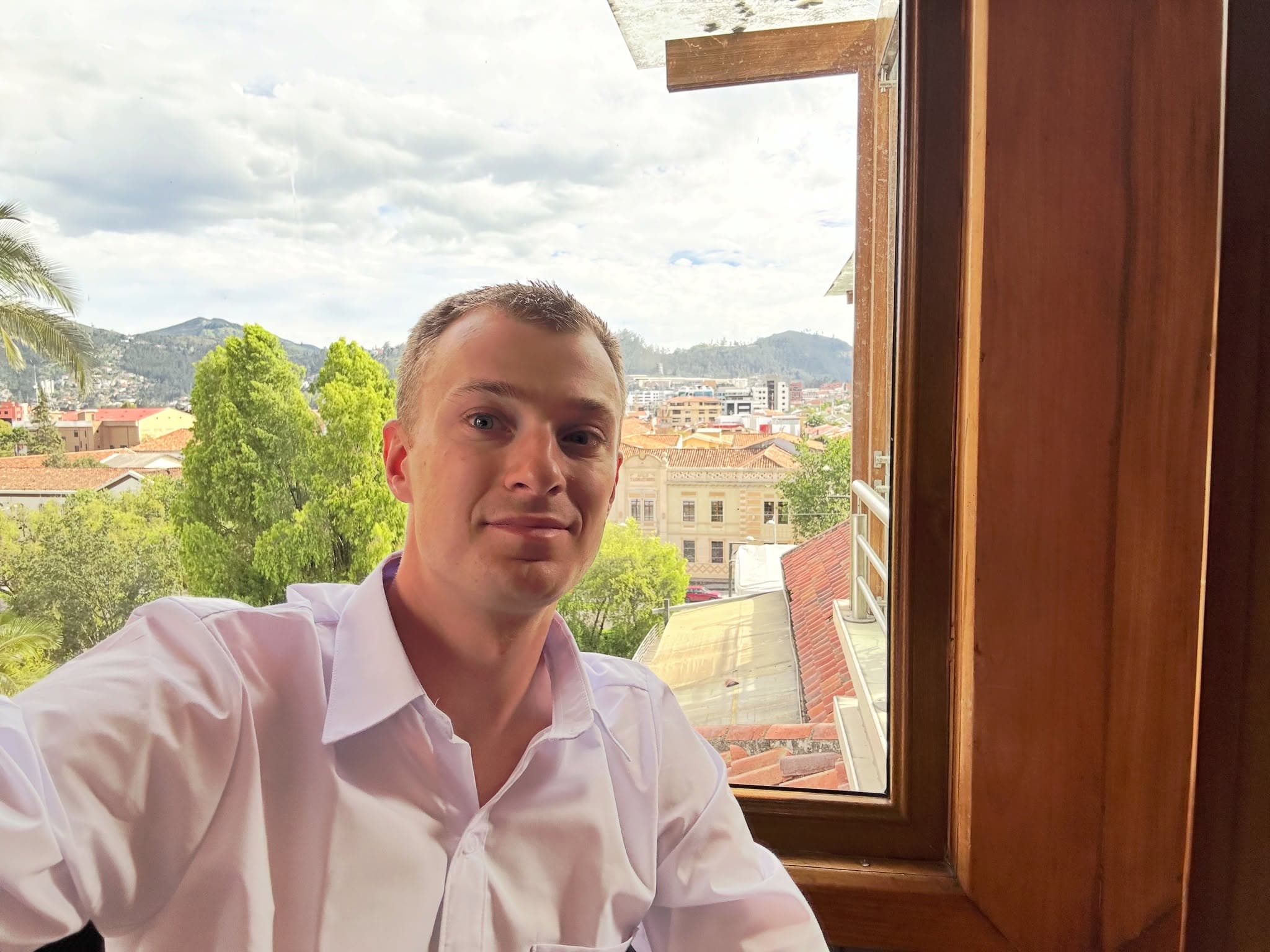
I live in Cuenca full-time. I went through Ecuador's immigration system myself — from SENESCYT registration through permanent residency. I built EcuaPass because I watched too many retirees get overcharged by lawyers or lose months to avoidable paperwork mistakes.
Your retirement should start with a plan, not a panic. That's what the free consultation is for.
Frequently Asked Questions

Your Retirement Shouldn't Wait
Book a free 30-minute consultation. We'll review your pension income, check your eligibility, and give you a clear timeline — whether you hire us or handle it yourself.
+593 96 284 8410
info@ecuapass.com
GET STARTED
Book Your Free Consultation
Get expert guidance on your Ecuador visa options within 24 hours.
Prefer to chat directly?
Message us on WhatsApp